Between August 10 and October 6, 2026, two AI labs announced results touching two of the Clay Millennium Prize Problems. Anthropic said an unreleased Claude model raised a long-standing bound on the zeros of the Riemann zeta function. OpenAI said an internal system proved that the Navier-Stokes equations can blow up in finite time, and a month later released several hundred manuscripts that included a proof of something called the quasi-Riemann hypothesis. A large part of the mathematical community responded with open letters.
I care about this for a specific reason. In early August I had a draft of this post arguing that AI would get good at “there exists” problems (find an object, check it) long before it got good at “for all” problems (prove something about infinitely many cases), and that the Riemann hypothesis and Navier-Stokes would need concepts nobody had yet. That draft is now wrong in at least one important place, and I would rather say so than quietly rewrite it.
I want to keep the claims, the formal checks, the outside scrutiny, and the dispute separate. They answer different questions.
What the two problems ask
The Riemann hypothesis is about the zeta function, which Riemann connected to how prime numbers are spread out. Its nontrivial zeros all lie in a vertical strip of the complex plane where the real part is between 0 and 1. Clay’s description says the hypothesis “asserts that all the ‘non-obvious’ zeros of the zeta function are complex numbers with real part 1/2.”1 The closer the zeros are to that line, the tighter the control on how far the count of primes can wander from its average.
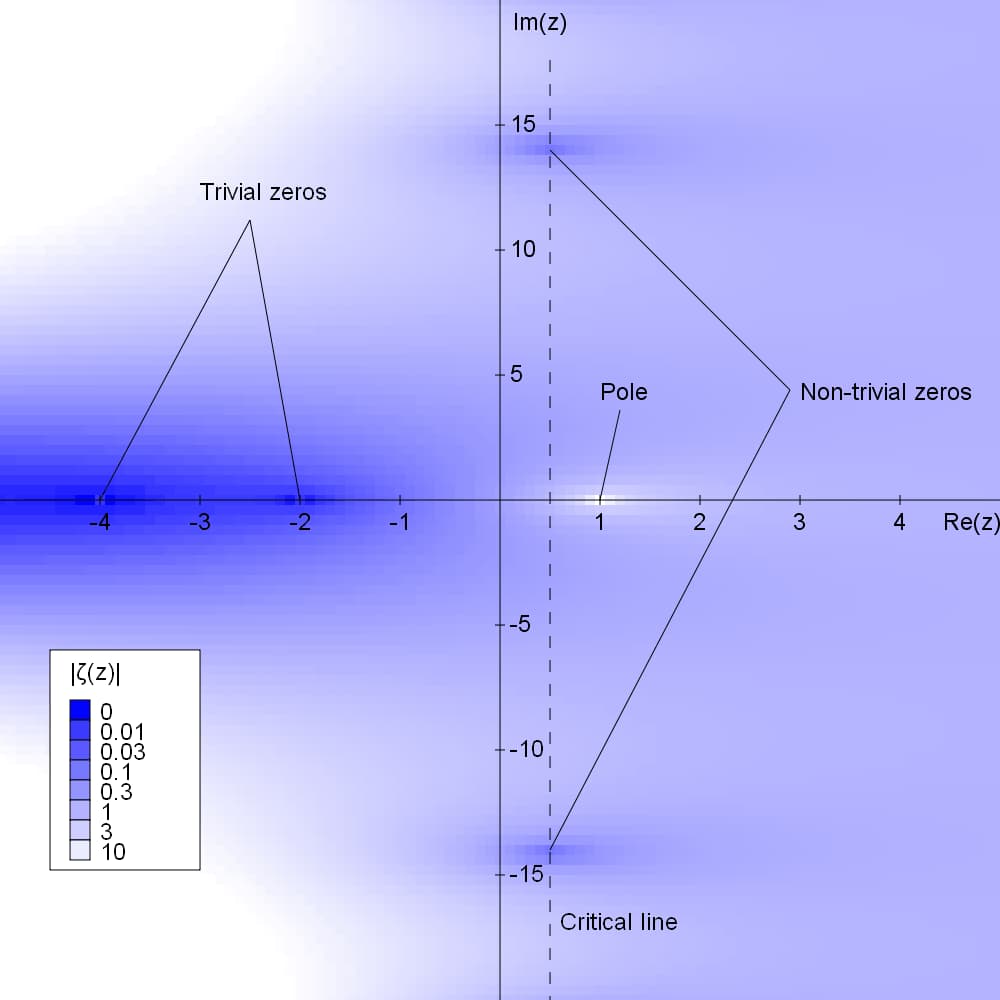
Numerically it is one of the best-tested claims in mathematics. Clay’s page says it “has been checked for the first 10,000,000,000,000 solutions.”1 Dave Platt and Tim Trudgian proved rigorously, with interval arithmetic, that every zero with imaginary part up to 3·10^12 is on the line.2 None of that is a proof, because there are infinitely many zeros above any height you check.
The Navier-Stokes problem is about the equations for an incompressible fluid like water. Charles Fefferman’s official problem statement asks for a proof of one of four statements.3 Statements (A) and (B) say that with no external force, every smooth, reasonable starting flow stays smooth forever (on all of space, or on a periodic box). Statements (C) and (D) say the opposite in a specific form: there exist a smooth starting flow and a smooth external force, with the force decaying in a prescribed way, for which no smooth solution exists for all time.
That detail matters for everything below. The two “breakdown” options in the official statement explicitly allow a smooth force. The two “everything stays smooth” options do not.
One more piece of background. In 2016 Terence Tao built an “averaged” version of Navier-Stokes that keeps the usual energy identity and harmonic analysis estimates, and showed its solutions can blow up.4 His conclusion was that any proof of smoothness “has to use finer structure on the nonlinear portion” of the equation. Before this summer, that was the strongest hint I knew of that blowup might be the true answer.
The claims, one at a time
Here is each claim with a status label. “Formalized” means a Lean proof exists and the authors say it checks. “Expert-checked” means named mathematicians outside the claiming team have said publicly that they believe it. “Disputed” means there is a public disagreement about credit or conduct, not necessarily about correctness.
August 10: Claude and the fraction of zeros on the line. Anthropic reported that an unreleased research version of Claude raised the proven lower bound on the fraction of nontrivial zeta zeros lying on the critical line, from 41.6% to 67.2%.5 This is not a zero-free region, which is how I first saw it described. It is a statement about what share of zeros is provably exactly where Riemann said, and it builds on a line of work that removed the assumption of the Riemann hypothesis from older techniques of Montgomery. Two Anthropic mathematicians, Levent Alpöge and Ralph Furman, checked the paper, outside experts Brian Conrey and Dan Goldston examined it on short notice, and Claude produced a Lean formalization. Anthropic was candid that the model had been asked to attempt the Riemann hypothesis itself and failed, writing: “We don’t expect that the techniques Claude used will lead to proving the Riemann hypothesis.”5 Status: formalized, checked in-house, seen by outside experts, not yet refereed as far as I can find.
September 7: Alpöge and Buckmaster, forced Euler. Late on September 7, Tristan Buckmaster of NYU released a statement and papers with Levent Alpöge, who works at Anthropic but described this as a personal collaboration.6 They claim finite-time blowup with smooth forcing for three fluid equations: incompressible porous media, Boussinesq, and 3D incompressible Euler (Euler is Navier-Stokes with the viscosity removed). They say the Euler result was verified in Lean on August 22, and that they believe they also have blowup for a “hypo-dissipative” Navier-Stokes variant whose Lean check had not finished. Buckmaster credits the underlying program to Diego Córdoba and Luis Martínez-Zoroa and says the models helped push that program “to completion.”6 Tao called it “a remarkable achievement” the next day.7 Status: formalized, with an early endorsement from Tao. Not the Millennium Problem, since Euler isn’t on Clay’s list.
September 8: OpenAI, forced Navier-Stokes. About 12 hours later, OpenAI posted “On the Navier-Stokes Millennium Prize Problem.”8 The claim, as stated in its Lean repository: for every positive viscosity, there exist smooth initial data and forcing on all of space, and separately on the periodic torus, for which no global smooth solution exists. OpenAI says this establishes statements (C) and (D) of Fefferman’s formulation. It also claims a separate result, blowup for the unforced 3D Euler equations from smooth, compactly supported initial data. The process: a group of on the order of 10,000 concurrent agents reached the Navier-Stokes result about 88 hours after launch, and Lean formalization took another 17 hours.8 OpenAI wrote, “We do not intend to claim the Millennium Prize for this result.” Status: formalized, not yet worked through in public by outside experts as far as I can find, and disputed (see below). Quanta’s coverage put the caveat well: “If the result holds up to further scrutiny,” it is by a wide margin the most important proof an AI has produced.9
October 6: OpenAI’s release, and the quasi-Riemann hypothesis. OpenAI published a GitHub repository of manuscripts from an internal model. Its README currently lists 719 manuscripts in 372 families, says about 42% of top-line results are formalized in Lean, and warns that “some of the unformalized results could have issues.”10 On October 7 the repository withdrew three manuscripts on Hodge-type questions after a sign error was found, and revised 14 others.10 Entry 003 is the quasi-Riemann hypothesis: a manuscript dated September 30 proving that every Dirichlet L-function, including the zeta function, has no zeros with real part greater than 7/8, plus a companion dated October 5 giving a different proof for real part greater than 11/12. Status: the 7/8 version is formalized in Lean (the repository’s Lean notes cover the zeta, Dirichlet, and Hecke statements). The 11/12 version is not formalized, but it is the one experts have been reading, and Quanta reports they largely agree it is correct.11
A note on the “1/8 to 7/8” versus “greater than 7/8” wording I saw in coverage: they are the same claim. The primary document proves the half-plane with real part above 7/8 is zero-free. Because the zeros are symmetric about the line at 1/2, that also clears the region below 1/8, so every nontrivial zero sits between 1/8 and 7/8.11
The dispute over Navier-Stokes
There are two separate arguments here, and they’re easy to blur.
The first is about credit. OpenAI’s post says its effort began on September 1 after hearing a rumor it later connected to Alpöge and Buckmaster, that its researchers and agents “did not see any of their work through any means until they released it publicly,” and that an investigation confirmed Buckmaster’s Codex prompts “could not have influenced the system in any way,” while adding that it “cannot rule out that de-identified data” from his usage helped improve its models. That finding covers only the two months of prompts before the announcement.8 OpenAI says it recognizes the priority of the forced Euler work, and that it reached out to offer a joint announcement. Quanta reported that both teams relied heavily on Córdoba and Martínez-Zoroa’s approach.9
The second is about conduct, and here I’m reporting one side’s account. Buckmaster’s statement describes calls on September 6 in which, he says, he was told OpenAI’s model had a roughly 100-page forced Navier-Stokes proof, that Sébastien Bubeck of OpenAI “twice asserted that he wanted Levent removed from authorship,” and that he was offered two publication arrangements, both of which he declined.6 He is careful about what he is not saying: “I have not seen OpenAI’s proof,” and “I am not accusing anyone of anything.” OpenAI’s post describes the same contacts as an offer of a concurrent release.8 I can’t adjudicate between the accounts, so I’ll leave it there.
What Buckmaster most wanted to talk about was the math. He called the month “a Deep Blue-Kasparov moment” and said that if OpenAI did close the gap, “it should be said loudly, by them, with the history intact.”6 I find that a useful way to keep the achievement and its history in view.
On correctness, the honest status is that a Lean certificate exists and that formalization is not the end of checking. Quanta notes that humans still have to confirm the Lean statement says what the paper claims.9 A proof can be machine-verified and still prove the wrong theorem if the formal statement is subtly off, for example in how the force’s decay is encoded. I haven’t seen anyone report such a problem. I also haven’t seen a named outside analyst say they’ve worked through the whole argument.
What mathematicians said
Tao’s reaction to the Euler papers is the one I found most revealing. He wrote that nothing seemed to prevent the methods from reaching Navier-Stokes, and that he “would not be surprised” if someone could do it with enough compute and AI help. Then: “such an exercise does not particularly hold my interest; I am far more interested in digesting the proof methods” and extracting what is new in them.7 I read that as a preference for understanding the method rather than racing to the next announcement.
On September 11, Tao posted a declaration titled “A Severe Misalignment of AI in Mathematics,” with 25 initial signatories, all Fields medalists, including Tao himself, Artur Avila, Manjul Bhargava, Pierre Deligne, Martin Hairer, Maxim Kontsevich, and James Maynard.12 Its central line: “The goals of the AI companies and the goals of the mathematical community are severely misaligned.” Its reasoning is that “solving problems is only a tool and proxy for achieving the primary goal of conceptual understanding and insight.” It worries that rushed announcements leave no time for proper write-ups and raise attribution and plagiarism questions. It does not call for a ban.
After the October 6 release, the Association for Human Mathematics posted a statement on Tao’s blog, signed by its communications working group rather than named individuals. It is much sharper: “Releasing over 700 files at once is not a demonstration of scholarship, but a demonstration of power.” It urges mathematicians “to discontinue their work with OpenAI.”13
The number theorists reading the quasi-Riemann proof, quoted by Quanta on October 19, were impressed and uncomfortable in roughly equal measure.11 Jared Duker Lichtman of Stanford called it “the most significant AI-for-math achievement so far, by quite a margin.” Maksym Radziwiłł of NYU said the implications are “staggering,” explaining that “the vast majority of consequences of RH already follow from quasi-RH.” He also said the papers “are horribly written (in a way that would lead to immediate rejection at any mathematical journal).” Alexander Dunn of Georgia Tech said, “The proof is a surprising synthesis of well-known ideas.” Peter Sarnak said he won’t treat it as a theorem until humans check and understand the details.
Tao’s Caltech lecture on October 9, “Math 2.0,” put a frame around all of this.14 His slides say “we are now entering an era of proof abundance in mathematics,” and that “AI performance is thus extremely jagged: astounding in some directions, while inadequate in others.” They also say, against the press-release impression, that “most of the problems at the current frontier of mathematics remain unsolved, even with massive computational expenditure.” His argument is that problem-solving was a good proxy for mathematical value when proofs were scarce, and it has become misaligned now that they aren’t. His views page, which he has an AI maintain, says that as of October 2026 he no longer sees a way to engage constructively with OpenAI, after years of holding that engaging with industry beat being hostile to it.15
What “quasi” means, and why it isn’t RH
The quasi-Riemann hypothesis is a weaker cousin of the real thing. Quanta’s description is that it asks only that all nontrivial zeros lie in a vertical strip narrower than the known one from 0 to 1.11 Any strip works, as long as it is a fixed amount narrower on both sides. Before this release, the best anyone could say for every zero was that its real part is less than 1, with no fixed margin.15
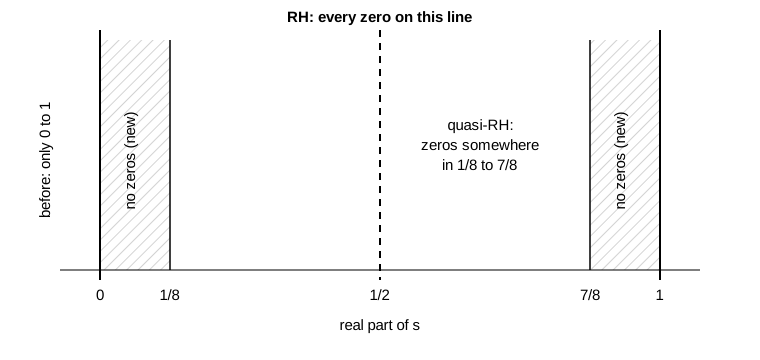
So the claim is that the hatched bands are empty. The Riemann hypothesis says everything except one line is empty. Between those two statements is an enormous amount of room, and the quasi result doesn’t tell you whether the zeros are on the line, near it, or spread across the middle three quarters of the strip.
Mathematicians still care a great deal, because a fixed zero-free margin gives much sharper control over primes, and here it holds for every Dirichlet L-function at once. That is the content of Radziwiłł’s remark that most consequences of RH already follow.11 Several manuscripts in OpenAI’s release already use the zero-free theorem as an input for other results, which is what you’d expect from a tool that strong.10
It is also not obviously a step toward RH itself. The Anthropic team said plainly they don’t expect their technique to reach the Riemann hypothesis,5 and I haven’t seen anyone claim the quasi-RH method extends to the line. The specialists Quanta quoted framed it as a huge result in its own right, not a near miss.11 I’d frame it the same way. The numerical checks establish where zeros sit up to a finite height; the new bounds constrain infinitely many zeros in different ways.
What this does to my search-versus-proof framing
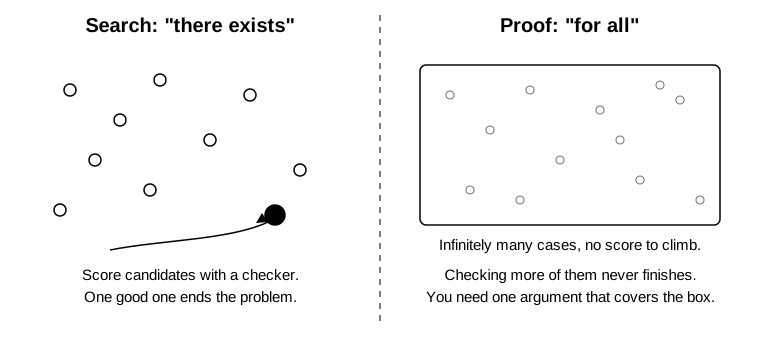
Two months ago I would have said that AI would settle the “there exists” half of open problems well before the “for all” half, and that results near the Riemann hypothesis would need a human idea at the center. Here is how that scored.
The Navier-Stokes claim fits the old framing almost exactly. Blowup is a “there exists” statement: build one starting flow and one force, then prove that this particular solution breaks down. It also fits the “human idea at the center” part, since Buckmaster, Tao, and Quanta all point to Córdoba and Martínez-Zoroa’s program as the foundation.679 The prediction was wrong about timing (I had said “the next decade”), not about shape.
The quasi-Riemann hypothesis breaks the framing. It is a pure “for all” statement: every zero of every Dirichlet L-function avoids a half-plane. The result is a universal statement, even if searching over possible arguments helped produce its proof. And according to the experts Quanta talked to, it didn’t need a new concept either. The proof found hidden connections between existing tools, building on a 2021 formula of Dunn and Radziwiłł.11 The Anthropic result is the same type: a statement about the proportion of all zeros, reached by pushing a known line of research.5
My specific mistake was treating “for all” as a stand-in for “needs an idea nobody has.” Those come apart. Some universal statements are blocked by a missing concept. Others are blocked by a combination of known ideas that nobody happened to put together, maybe because it spanned too many subfields or looked unpromising. A system that can read everything and try thousands of combinations is very good at the second kind, and the second kind turned out to include a problem that number theorists considered out of reach. Thomas Bloom, talking to Quanta about which problems still look like they need new ideas, said: “we would have said the same about quasi-RH a few weeks ago!”11
The part I still think holds is that verification is the bottleneck, and it is now a much bigger one. A release where 42% of top-line results are formalized, where three papers were withdrawn within a day, and where the most important result is described by an admiring expert as “horribly written” is a release that will take the field years to absorb.1011 Tao’s comment on the Euler work points at the same gap: the proof exists, and the understanding hasn’t been extracted yet.7
Where I stand now
I think the quasi-Riemann hypothesis is very likely true as proved. The 7/8 version has a Lean certificate, and the 11/12 version has specialists saying they can follow it.1011 I think the forced Navier-Stokes blowup is plausible, but I’d want a named analyst outside OpenAI to say they’ve checked the formal statement against Fefferman’s conditions before calling it settled. The Lean proof makes me much more confident than I’d be about a 100-page human preprint, but “formalized” is not the same as “the formal statement matches the problem.”
The unforced question is still open. Nobody has shown that a smooth flow with no external push ever blows up, and nobody has proved the opposite. Clay’s page still lists the Navier-Stokes problem with the status “Active.”3 I don’t think OpenAI’s claim is a trick, because the official statement allows a smooth force, but I also think most people hearing “AI solved Navier-Stokes” picture something stronger than what is claimed.
On the Riemann hypothesis itself, I no longer trust my own reasons for saying “not soon.” My August reason was that it needs a concept that doesn’t exist yet. That might be right. But a few weeks ago experts would have said something similar about quasi-RH, and it turned out to be a matter of combining known things in a way nobody had tried. I don’t know which kind of problem RH is, and I don’t think anyone can tell from outside until someone succeeds.
On the open letters, I mostly agree with the Fields medalists and less with the AHM statement. The misalignment argument seems right to me: labs use famous problems as benchmarks, and a benchmark is finished once the answer is known, while a problem’s value to mathematicians was largely in what people learned on the way there. Telling mathematicians to stop working with one company seems less likely to fix that than paying for the slow work of understanding these proofs and writing them up properly.
What I find so surprising is the possibility of having a proof before people have had time to understand what it teaches us. If results arrive faster, how do mathematicians decide which ideas deserve a closer look? Who does the work of turning a difficult argument into something others can learn from?
I’d be excited to see these tools help with that work too. Finding a result opens a door, but explaining why it works could open many more. The future I want to follow is what people discover once they can start building on these arguments, with the claims checked carefully enough to support that next step.
Sources
Footnotes
-
Clay Mathematics Institute, “Riemann Hypothesis” (Millennium Prize Problem page, with official description by E. Bombieri), claymath.org, accessed October 2026. https://www.claymath.org/millennium/riemann-hypothesis/ ↩ ↩2
-
Dave Platt and Tim Trudgian, “The Riemann hypothesis is true up to 3·10^12”, Bulletin of the London Mathematical Society 53, 792–797, 2021. https://arxiv.org/abs/2004.09765 ↩
-
Charles L. Fefferman, “Existence and smoothness of the Navier-Stokes equation”, official Millennium Prize Problem description, Clay Mathematics Institute, 2000; problem status from the Clay page https://www.claymath.org/millennium/navier-stokes-equation/, accessed October 2026. https://www.claymath.org/wp-content/uploads/2022/06/navierstokes.pdf ↩ ↩2
-
Terence Tao, “Finite time blowup for an averaged three-dimensional Navier-Stokes equation”, Journal of the American Mathematical Society 29, 601–674, 2016. https://arxiv.org/abs/1402.0290 ↩
-
Anthropic, “Claude has improved on a longstanding lower bound for the fraction of zeros of the Riemann zeta function that satisfy the Riemann hypothesis”, anthropic.com, August 10, 2026 (updated August 13, 2026); Lean formalization at https://github.com/anthropics/zeta-23-lean. https://anthropic.com/research/riemann-zeta ↩ ↩2 ↩3 ↩4
-
Tristan Buckmaster, statement on results with Levent Alpöge (finite-time blowup with smooth forcing for IPM, Boussinesq, and 3D Euler), NYU Courant Institute, September 7, 2026. https://cims.nyu.edu/~tristanb/statement.pdf ↩ ↩2 ↩3 ↩4 ↩5
-
Terence Tao, thread on Alpöge and Buckmaster’s blowup results (parts 1/2 and 2/2), Mathstodon, September 8, 2026. https://mathstodon.xyz/@tao/117233527638291447 ↩ ↩2 ↩3 ↩4
-
OpenAI, “On the Navier–Stokes Millennium Prize Problem”, openai.com, September 8, 2026; Lean repository with theorem statements at https://github.com/openai/NavierStokesAndEuler. https://openai.com/index/navier-stokes-solution/ ↩ ↩2 ↩3 ↩4
-
Konstantin Kakaes, “AI Has Solved One of Math’s $1 Million Millennium Prize Problems”, Quanta Magazine, September 8, 2026. https://www.quantamagazine.org/ai-has-solved-one-of-maths-1-million-millennium-prize-problems-20260908/ ↩ ↩2 ↩3 ↩4
-
OpenAI, “openai/math” repository (README, CONTENTS.md entry 003, history.md, and lean/docs/003.md), GitHub, released October 6, 2026, accessed October 2026. https://github.com/openai/math ↩ ↩2 ↩3 ↩4 ↩5
-
Konstantin Kakaes, “AI Proved the Quasi-Riemann Hypothesis. What Happens Now?”, Quanta Magazine, October 19, 2026. https://www.quantamagazine.org/ai-proved-the-quasi-riemann-hypothesis-what-happens-now-20261019/ ↩ ↩2 ↩3 ↩4 ↩5 ↩6 ↩7 ↩8 ↩9 ↩10
-
Terence Tao (posting the declaration of 25 Fields medalists), “A Severe Misalignment of AI in Mathematics”, What’s new (blog), September 11, 2026. https://terrytao.wordpress.com/2026/09/11/a-severe-misalignment-of-ai-in-mathematics/ ↩
-
Association for Human Mathematics Communications Working Group, “AHM Statement on OpenAI’s October 6 Release of Mathematical Documents”, guest post on What’s new (Terence Tao’s blog), October 7, 2026. https://terrytao.wordpress.com/2026/10/07/ahm-statement-on-openais-october-6-release-of-mathematical-documents/ ↩
-
Terence Tao, “Math 2.0” (slides, AIM Public Lecture Series, Caltech, October 9, 2026), posted October 10, 2026. https://teorth.github.io/tao-web/slides/math-2-0-caltech-2026.pdf ↩
-
Terence Tao, AI-maintained summary of his views on AI and mathematics, teorth.github.io, accessed October 2026. https://teorth.github.io/tao-web/ai-views.html ↩ ↩2